According to the information available to us, in none of these cases were the owners served with a decision issued by a competent authority ordering the demolition. The owners received only notices from the publicly owned enterprise Ibar-Lepenac/Ibër-Lepenc. Such a notice cannot replace a formal decision by a competent judicial, inspection or administrative authority against which the owner may lodge an appeal or pursue another legal remedy.
Law No. 05/L-031 on General Administrative Procedure establishes the principle of legality (Article 4), the principle of proportionality (Article 5) and the right to legal remedies (Article 13). Law No. 04/L-110 on Construction regulates inspection oversight and the demolition of structures. If no decision by a competent authority exists, the institutions must explain the legal instrument on the basis of which the demolition was carried out.
It is particularly concerning that the police are providing assistance during the demolitions even though the owners have not been served with decisions issued by the competent authorities. Police assistance cannot replace a decision by a competent authority, nor can it in itself create a legal basis for demolition. The institutions must explain the enforceable instrument on the basis of which the police are intervening and identify who issued the order for their deployment.
It is additionally problematic that structures are being demolished while proceedings initiated by their owners remain pending before the courts. The most recent such case is the demolition of the Jezero Motel, despite a hearing before the Basic Court in Mitrovica having been scheduled for 12 August 2026. Demolition before the conclusion of judicial proceedings may render judicial protection devoid of purpose and make any subsequent judgment in the owner’s favour practically unenforceable, thereby calling into question the right to effective judicial protection and an effective remedy.
The issues of proportionality and legitimate expectations are particularly important. Many of the structures have existed for one or several decades, substantial funds have been invested in them, and no prior inspection warnings or demolition orders were issued. The institutions’ prolonged inaction, despite publicly available information about the construction of structures at Gazivode/Ujmani Lake, is relevant to the assessment of legal certainty and legitimate expectations.
In this regard, we emphasise that, in Hamer v. Belgium, the European Court of Human Rights indicated that the authorities’ prolonged tolerance of a structure may be relevant to the existence of a legitimate expectation and to the assessment of the proportionality of its subsequent demolition. The Court did not, however, consider that such tolerance in itself legalises unauthorised construction.
Given that some of these structures are homes in which people actually live and which have existed for several decades, their demolition constitutes an interference with the right to respect for the home under Article 8 of the European Convention on Human Rights. Protection of the home under the Convention does not depend solely on whether a structure has formal legal status, but also on the existence of sufficient and continuous links between an individual and that place. The European Court has specifically emphasised that, where the demolition of a home is concerned, the person affected must be afforded an individual assessment of proportionality, including the consequences that the demolition would have for that individual and their family.
If the demolitions are justified on the grounds of water protection, the institutions must demonstrate the specific risk posed by each individual structure and explain why less restrictive measures, including measures addressing wastewater disposal and treatment, would not be sufficient. In this regard, it should be noted that structures not located on the shore of Gazivode/Ujmani Lake have also been demolished.
Finally, we demand the equal application of the law. Structures also exist in other protected areas, including at Batllava Lake, where owners were able to exercise their right to a legal remedy and demolitions were stayed pending the conclusion of the relevant proceedings. A similar situation exists in relation to structures in Sharri National Park. These examples therefore require a clear explanation of the criteria applied by the institutions when deciding how to proceed.
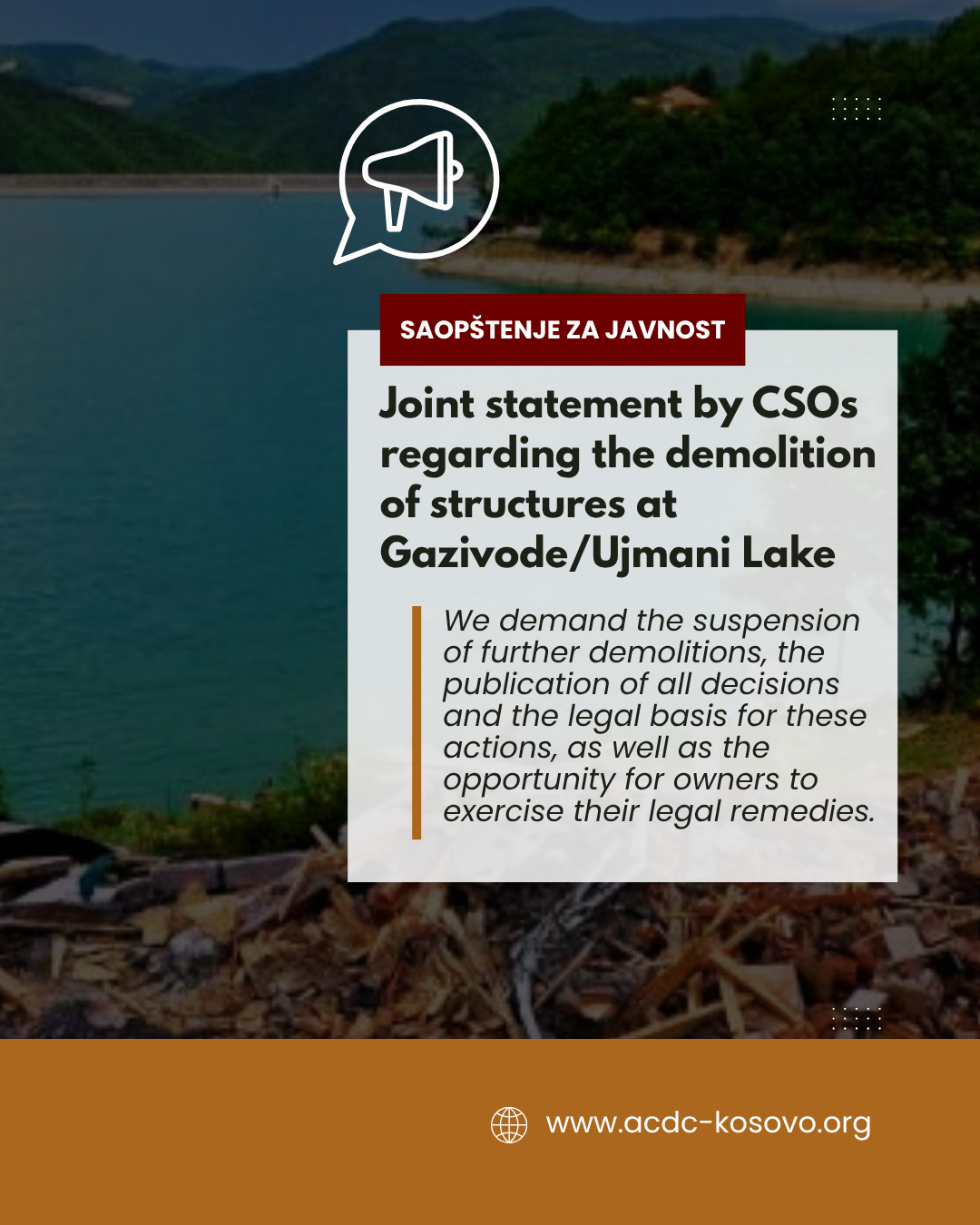
In view of all the above, we call for an immediate suspension of any further demolitions; the publication of all decisions, inspection reports and the legal basis for police assistance; and the disclosure of evidence demonstrating that the owners were given an opportunity to exercise their right to legal remedies and that an individual proportionality assessment was conducted.
We call upon the competent institutions to enter into direct dialogue with the owners. We also call upon the international missions and diplomatic representations in Kosovo to become actively involved in finding a solution that simultaneously safeguards legality, the public interest, the environment and the rights of the owners of the structures concerned.
- Advocacy Center for Democratic Culture (ACDC)
- New Social Initiative (NSI)
- AKTIV
- Institute for Territorial Economic Development (InTER)
- Center for Affirmative Social Actions (CASA)