
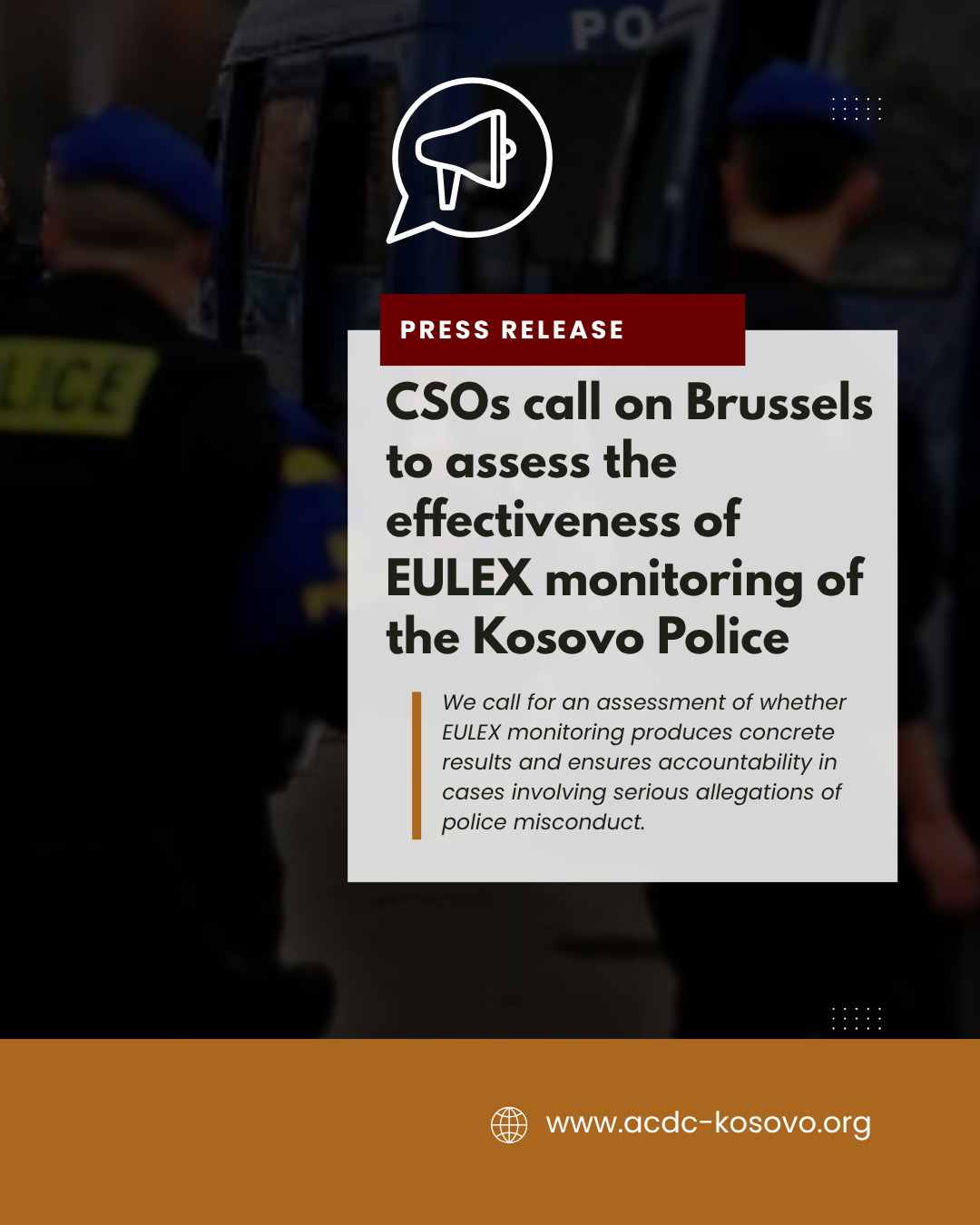
At the same time, this case represents yet another reason for our serious concern about the way monitoring of the Kosovo Police is being conducted and the results that this monitoring produces.
Over the past several years, we have repeatedly approached local EULEX representatives, raised concerns about allegations of police abuse and other questionable conduct by the Kosovo Police, and called on the Mission to publicly communicate its findings and assessment in specific cases. As early as October 2024, we publicly stated that the continued silence of EULEX regarding allegations of unlawful or questionable police conduct was no longer acceptable.
We do not expect EULEX to prejudge any case or to replace the competent investigative and judicial authorities. However, we do expect independent monitoring to help establish what happened, identify patterns and, where serious problems are identified, exert sufficient institutional pressure to ensure corrective action.
Unfortunately, we believe that our efforts and years of communication with local EULEX representatives have not been sufficient to exert effective pressure on the Kosovo Police to prevent and address practices that cause serious concern.
We are particularly concerned that citizens do not report all cases of police abuse because of fear, distrust or the belief that reporting will not lead to meaningful consequences. Even in cases where citizens have reported alleged abuse to the Police Inspectorate, the absence of visible accountability and concrete corrective measures further undermines confidence in existing accountability mechanisms. The number of publicly known cases therefore cannot necessarily be taken as an indication of the actual scale of the problem.
For all these reasons, we have decided to go beyond engagement with local EULEX representatives and have directly addressed the higher level in Brussels – the Civilian Operations Headquarters (CivOpsHQ) of the European External Action Service (EEAS), and the Civilian Operations Commander responsible for EU civilian missions.
We are asking the relevant authorities in Brussels for a written assessment of the effectiveness of EULEX's monitoring of the Kosovo Police. This is a demand for accountability of the international monitoring mechanism itself.
If EULEX identifies serious problems in the conduct of the Kosovo Police, but the public receives no assessment of those findings and there is no visible outcome of that monitoring, a fundamental question arises: what is the actual effect of the monitoring, and what pressure does it exert on the institutions that are supposed to be accountable for their conduct?
- New Social Initiative - Nova društvena inicijativa
- Institute for Territorial Economic Development
- Ngo Aktiv
- Center for Affirmative Social Actions – CASA
- Advocacy Center for Democratic Culture – ACDC