Because they frequently encounter difficulties in exercising their rights, members of the Serbian community in Kosovo understand well how important it is for rights to exist beyond paper. It is not enough for the law to guarantee a particular right if it cannot be exercised in everyday life. Serbs in Kosovo also understand well what it means to be in a minority, especially when the majority does not sufficiently understand their needs and problems.
In such circumstances, an entirely understandable question may arise: if the Serbian community already faces obstacles in exercising its rights because of its ethnicity, why also raise issues of discrimination based on other personal characteristics? Why discuss the situation of sexual minorities or other marginalized social groups while we are still fighting to exercise basic rights?
The answer to these questions lies in the fact that no community is made up of people who are all exactly alike.
When we discuss the situation of the Serbian community in Kosovo, we most often view it through the lens of its ethnicity. Ethnicity shapes many of the issues its members face every day. However, ethnicity is not the only characteristic that defines our identity and our position in society.
Every ethnic community includes women and men, younger and older people, believers and atheists, people with different levels of education and financial circumstances, people with disabilities, and people of different sexual orientations and gender identities. This is why people belonging to the same ethnic community do not all have the same experiences.
A woman and a man from the same community may face the same difficulties in exercising their language rights, but their experiences in other areas of life may differ. A person with a disability may encounter additional barriers to accessing institutions. A member of a sexual minority may share the problems faced by their ethnic community while also experiencing additional discrimination because of another aspect of their identity. In other words, belonging to a community that is in a minority does not mean that all its members are in the same position.
Ethnicity is an important part of our identity, but it is not the only characteristic that makes us different. It is therefore not the only ground on which we may face discrimination or be placed at a disadvantage.
The very experience of living as a non-majority community in Kosovo can help the Serbian community better understand other forms of minority experience.
If we know what it is like to have to constantly explain why our rights matter, we should find it easier to understand others when they are in a similar situation. If we know how difficult it is when someone sees us primarily in terms of our membership of a particular group or a personal characteristic, we can more easily understand why it is important not to do the same to others.
There are minorities within minority communities, too. Some individuals, in addition to the problems they share with their community, face further forms of discrimination because of other personal characteristics. Members of sexual minorities are among them.
Their rights are sometimes discussed as though they were an issue unrelated to the everyday life of our community. However, members of sexual minorities are not a separate group that exists somewhere else. They are part of our families, schools, workplaces, neighborhoods and circles of friends. They belong to the Serbian, Albanian, Bosniak, Roma and other communities. Like everyone else, they belong to different social groups at the same time.
We may often be unaware of a person's sexual orientation or gender identity. This very fact can tell us a great deal about the social environment in which we live. If someone feels they must hide part of their identity for fear of judgment, rejection, discrimination or violence, the issue is no longer only about their private life. It becomes a matter of freedom, safety and dignity.
We do not need to have this experience ourselves to understand that it is not easy to constantly assess whom we can tell something about ourselves and what reaction it might provoke. Something that is entirely ordinary for most people may carry a fear of judgment or consequences for someone else.
We do not all have to live in the same way. We do not have to share the same beliefs, the same understanding of family, the same values or the same attitudes toward private life. No one is obliged to like every choice, characteristic or way of life of another person. A democratic and tolerant society does not rest on everyone approving of everyone else's choices and way of life. Yet there is a clear difference between disliking something and, because of that, denying another person's right to live their life as they wish.
Another person's identity, private life or relationship does not, in itself, take anything away from our rights. If someone lives differently from me, that does not threaten my faith, values or rights. We can lead completely different lives while still accepting that no one should be attacked, insulted, discriminated against or forced to live in fear simply because a characteristic of theirs makes them different from the majority.
This is why the experience of living in a community that is in a minority because of its ethnicity can help us better understand other forms of minority experience. It can remind us how important it is for others to respect our dignity and not deny us rights because we differ in some way. If we ask this for ourselves, we should recognize the same principle for others.
Ultimately, we are all different. None of us is only a Serb, an Albanian, a Bosniak or a member of another community. Each of us has multiple identities, characteristics and experiences that make us who we are. In one situation, we may belong to the majority, and in another, to a minority. That is why no one's safety and dignity should be threatened simply because they differ from others in some way.
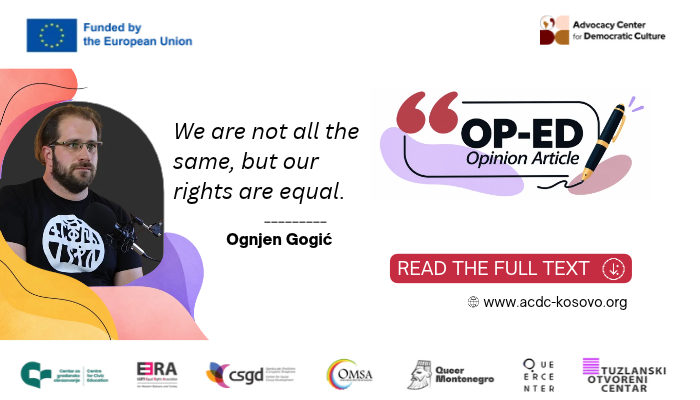
We are not all the same, but our rights are equal.
Ognjen Gogić